Full-Service Digital Agency: What They Do & Why You Need One
The evaluation framework most founders wish they had before their first agency engagement went sideways.
WeezLab10 min read
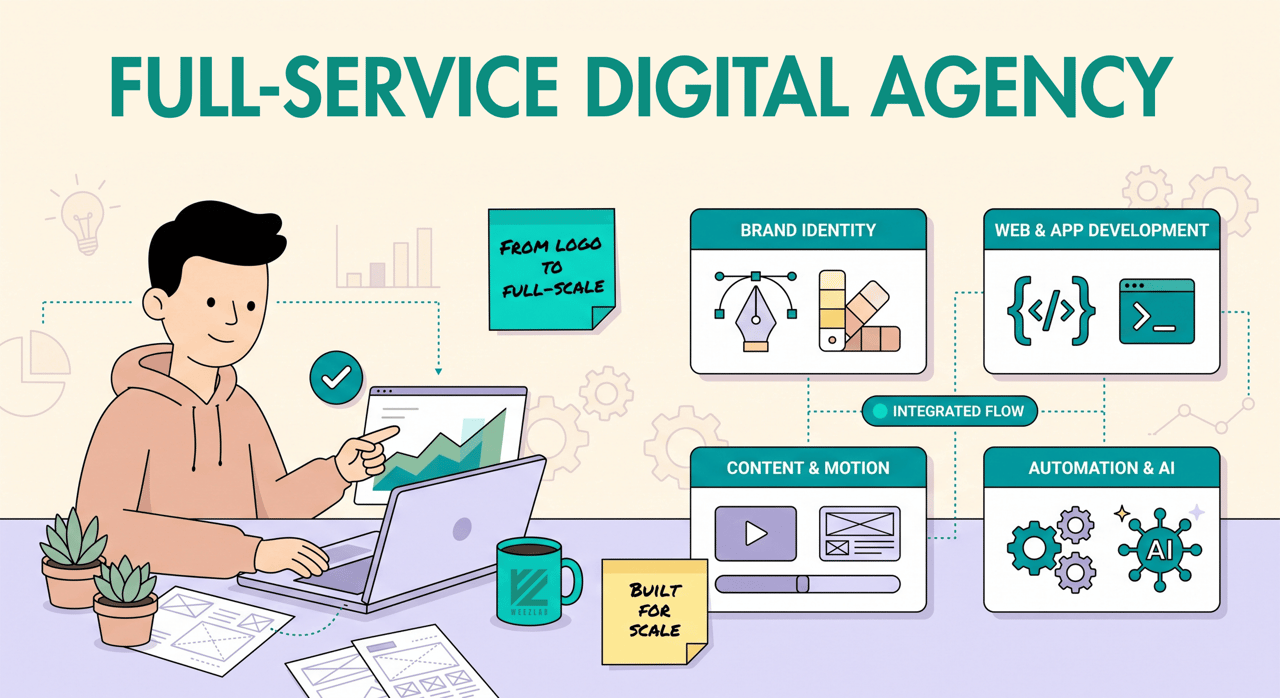
You've hired a brand designer, a web developer, a social media manager, and an SEO freelancer. Each one is doing decent work in isolation, but nothing connects. Your brand looks different on every platform, campaigns launch late because teams aren't talking to each other, and you're spending more time managing vendors than building your actual business. That gap between effort and output is frustrating, and it's common. It's also exactly what a full-service digital agency is built to eliminate, one coordinated team handling brand identity, web development, content creation, and AI-powered automation under a single strategy.
WeezLab is built specifically around this integrated model. It's not a new concept, but well-executed integrations are less common than buyers expect. Many agencies focus on one or two core services and outsource or add on the rest, which creates a different version of the same vendor fragmentation problem, just with fewer invoices.
By the time you finish reading, you'll know exactly what services to expect from a genuine end-to-end agency, what a realistic retainer costs, what ROI benchmarks to hold them to, and the specific questions to ask before you sign anything. Consider this the evaluation framework most founders wish they'd had before their first agency engagement went sideways.
What a full-service digital agency actually covers
Most founders assume "full service" means SEO and social media managed by the same team. The real scope is considerably broader, and understanding it is the first step to evaluating whether an agency's offer matches your actual needs.
Brand identity and strategic positioning
Most serious engagements start with brand: logo, visual system, messaging architecture, and market positioning. This isn't the aesthetic layer that gets slapped on at the end. It's the strategic foundation that every other deliverable builds on. When branding lives inside the same agency as web design and content production, the visual language stays consistent from the homepage to the Instagram grid to the email footer, because the same team created all of it.
Web design, development, and technical optimization
At a genuine digital marketing firm, "web" means custom design, front-end and back-end development, landing pages, e-commerce builds, CMS setup, and technical SEO. This is more than a website, it's a conversion asset that needs to load fast, render cleanly on every screen, and feed directly into the marketing stack. A slow or disjointed site doesn't just hurt user experience; it actively reduces the return on every dollar you spend driving traffic to it.
Content creation and channel management
The content scope inside a true one-stop marketing agency covers copywriting, blog strategy, graphic design, video production, and social media content. The critical advantage here is that when content is created inside the same team that built the brand and the website, voice and visuals are already defined. There's no briefing process, no style guide PDF being emailed back and forth, no revision round dedicated to "making it sound more like us." The baseline is already set.
Automation and AI-powered workflows
This is the layer most founders overlook until they're ready to scale. It includes CRM setup, email sequences, lead capture flows, chatbot integrations across WhatsApp and Meta DM, and API connections between tools. When built properly, this automation layer turns a strong digital presence into a system that generates and nurtures leads around the clock, shifting the founder's attention from data entry toward actual decisions.
Why building a vendor patchwork almost always backfires
The argument for keeping specialists separate sounds logical: best-in-class for each function, no single point of failure, easy to swap out underperformers. In practice, this model introduces hidden costs that don't show up in initial quotes.
Miscommunication eats your budget
When five vendors work independently, the brand designer doesn't know what keywords the SEO team is targeting, and the developer hasn't seen the messaging framework the copywriter built. Deliverables don't reinforce each other, campaigns underperform, and assets get rebuilt. The coordination overhead is a real financial cost, it just shows up in your calendar rather than on an invoice.
Inconsistency erodes brand trust
Audiences notice when your website, ads, emails, and social posts feel like they were made by different teams for different companies. Brand inconsistency is a visible trust signal that works against you. Research and case studies consistently indicate that cohesive brand presentation correlates with improved business outcomes, because people recognize and buy from brands that look and sound like a unified entity. A fragmented visual identity tells the market your operation is fragmented, even when it isn't.
Speed suffers when handoffs multiply
Every vendor relationship adds a handoff. A landing page that might take two weeks inside an integrated team can stretch to six when the designer, developer, and copywriter are working separate project queues on different schedules. That delay is real, and avoidable. Speed to market is a competitive advantage, and distributed vendor relationships quietly kill it.
What the model looks like when it's working
Understanding the theory is one thing. Seeing how it plays out in execution is what separates genuine integrated agencies from repackaged vendor collections.
One strategy, every channel
A genuine end-to-end agency begins each engagement with a single strategic layer that governs every deliverable. Channel selection, messaging hierarchy, content cadence, and performance goals are decided together before execution begins. In practice, that means the thinking behind the brand identity also informs the ad copy and the automation logic. There's no versioning problem because there's only one version of the strategy, shared across every function.
Execution that reduces founder management burden
Day-to-day for a founder working with this model typically looks like one point of contact, one reporting dashboard, and one invoice. The internal coordination happens inside the agency. A good account lead handles the project-management layer, which means the founder's role is reviewing and approving work, not chasing updates across four Slack workspaces and three different project tools.
Real results the model produces
The outcomes from well-executed integrated engagements can be significant. One direct-to-consumer e-commerce brand grew from $392K to $2.3M in revenue through combined paid media and SEO over an 18-month period. A B2B professional services firm saw 218% deal volume growth after integrating web development, HubSpot setup, SEO content, and email automation. A real estate platform doubled monthly traffic and increased lead generation by 50% following a full digital experience overhaul. These results reflect what happens when strategy, execution, and optimization share the same team and the same goal, rather than being managed across separate vendor relationships.
The goal isn't the cheapest agency or the most recognized one. It's the agency whose model, team, and process match exactly what you're trying to build.
What to expect from a retainer: pricing, timelines, and deliverables
Pricing in this category varies widely, and the first number in a proposal will anchor your thinking whether you want it to or not. Here's what the market actually looks like.
Pricing by business size
Small businesses typically land between $2,500 and $10,000 per month for a full-service retainer. Mid-market companies fall in the $8,000 to $25,000 range. Enterprise programs generally start at $15,000 and scale from there depending on scope, channel mix, and team seniority. These numbers reflect scope of work, not agency brand recognition. A boutique shop with a tight integration model can outperform a large agency running siloed teams at double the price.
Onboarding timelines and the ramp-up reality
Active work typically begins two to four weeks after contract signing, once accounts are audited, tracking is set up, and the strategic foundation is in place. The first 30 to 90 days are a setup and ramp-up phase, not a performance phase. Performance data starts to become meaningful around the 60-to-90-day mark, once campaigns have enough history and tracking is clean. Founders who expect material results in week one are setting themselves up for disappointment, and pushing the agency toward short-term vanity metrics rather than durable growth.
What's included vs. what gets billed separately
Ad spend, one-time website builds, custom video production, CMS licenses, and onboarding fees are rarely inside the base retainer. Ask for a clear scope breakdown that separates retainer services from billable add-ons before you sign anything. Contract lengths typically run three to six months minimum, with six-to-twelve-month terms being standard for full-service digital agency engagements. Month-to-month arrangements exist but usually carry a pricing premium.
ROI benchmarks: what "good results" actually looks like
Agency proposals are full of implied promises. The benchmarks below give you a calibrated frame for evaluating those claims.
Blended ROI over time
Industry benchmarks suggest integrated programs typically target 3:1 to 5:1 ROI in the first 12 months. Mature programs can reach 5:1 to 10:1 as SEO compounds and conversion rate optimization lifts the efficiency of all traffic. Paid search alone commonly delivers 2:1 to 4:1; organic SEO can reach 5:1 to 10:1 over a multi-year horizon. The integrated model captures both the short-term demand generation from paid media and the compounding efficiency gains from organic search, which is where blended return tends to outperform any single channel.
Conversion rate and CPL benchmarks
High-intent landing pages typically convert at 3 to 8 percent for organic traffic. Blended cost per lead falls as organic traffic scales, because compounding traffic doesn't require ongoing ad spend to maintain. CRO investments can deliver meaningful ROI lifts when applied to sufficient traffic volume; according to Invesp's CRO benchmarking research, the average return from structured conversion optimization programs is around 223%. These numbers aren't guarantees, but they're realistic targets to discuss with any agency before the engagement begins.
How to hold an agency accountable
Any credible full-service digital marketing agency should define success before the engagement starts: CPL targets, conversion rate goals, traffic growth benchmarks, and reporting cadence. These should be in the contract, not referenced verbally during the sales call. If an agency can't articulate what the KPIs are and how they'll be measured, accountability is not built into their operating model.
The questions to ask before signing with any agency
The proposal stage is where most buyers get sold rather than informed. These questions shift the dynamic.
Questions about their integration model
Ask how brand, web, content, and automation teams communicate internally. Ask to see a project where all services were deployed together and what the measurable outcome was. Ask who owns strategy versus who owns execution, and how context is preserved across handoffs. A genuine full-service digital agency will have practiced answers to all of these. A repackaged group of freelancers will hesitate, generalize, or pivot to showing you their portfolio instead.
Questions about contracts, data ownership, and exit terms
Ask what the minimum contract length is and what the notice period looks like. Ask explicitly who owns the ad accounts, CMS, domain, and all creative assets at the end of the engagement. Data and account ownership should always belong to the client. If the answer is vague, the contract will likely reflect that vagueness, and you'll discover the specifics at the worst possible moment.
A simple scoring checklist to use before deciding
Run any agency you're seriously considering through these five criteria before making a final call:
- Integration is genuine, not assembled: the team shares strategy, not just a brand name.
- Pricing is transparent: scope is defined, and retainer services are separated from add-ons.
- Case studies match your context: industry, business size, or challenge type align with yours.
- Reporting and KPIs are agreed upfront: success is defined before the contract is signed.
- Contract terms are client-friendly: clear exit provisions, defined notice periods, and explicit data ownership language.
Run two or three agencies through this framework side by side. The scoring doesn't need to be complex, it just needs to be consistent.
The structural advantage nobody talks about enough
A full-service digital agency isn't just a convenience. It's a structural advantage. When branding, web, content, and automation share the same strategy and the same team, the result is a digital presence that's faster to build, more consistent to maintain, and more effective at converting attention into revenue. The efficiency gains compound over time, and brand coherence becomes a competitive differentiator in its own right.
The evaluation framework is clear: know the full scope of digital agency services on offer, benchmark pricing against market data, hold the agency to defined ROI targets, and ask the hard questions before the contract is signed. The goal isn't the cheapest agency or the most recognized one. It's the agency whose model, team, and process match exactly what you're trying to build.
If you're ready to apply this framework to your own shortlist, reach out to the WeezLab team directly. Come with the scoring checklist, ask the questions that matter, and get a straight answer on whether the model is actually the right fit for where you're headed.