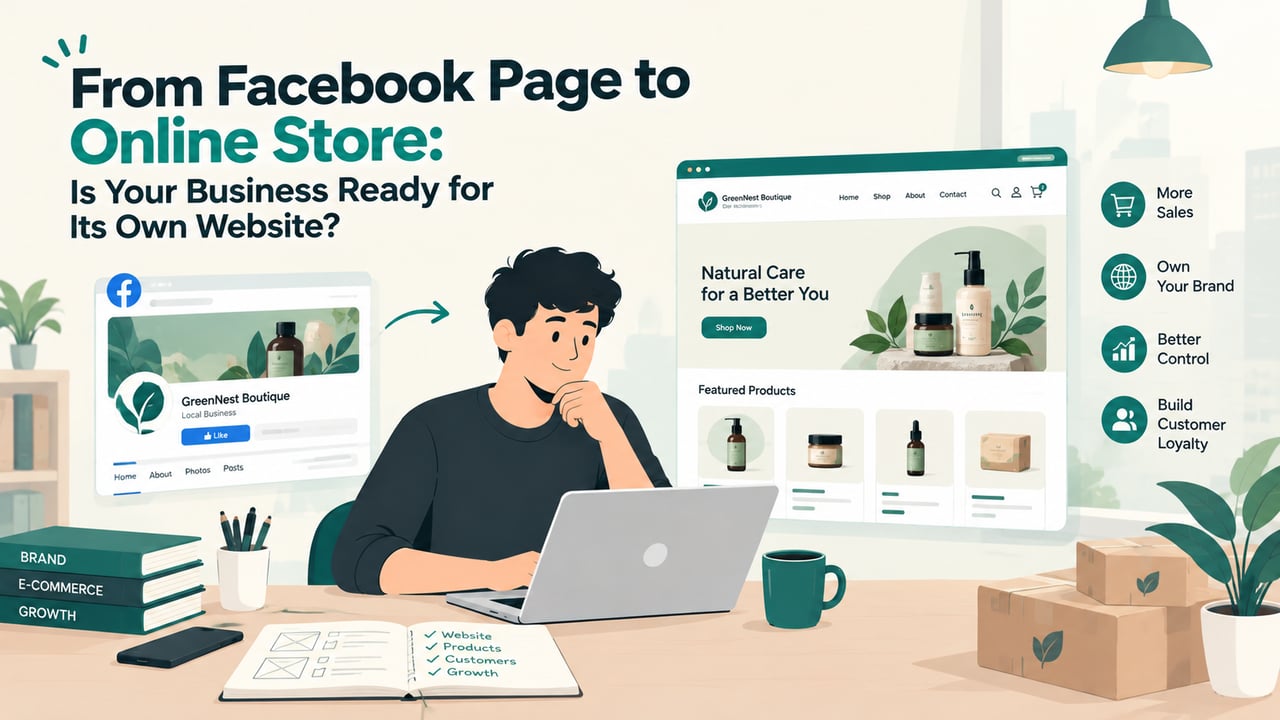
From Facebook Page to Online Store: Is Your Business Ready for Its Own Website?

Md Abdus Sami Akanda
Front-End & UI Developer
A post goes well. By evening there are eighty comments asking "price?", forty unread messages, and someone on the team is copying names, phone numbers and addresses from Messenger into a spreadsheet, checking stock by memory and booking couriers one parcel at a time. For thousands of businesses in Bangladesh, that is what selling online looks like, and for a while it works.
Then it stops working. Orders get missed, the same five questions eat the day, a product sells twice because the sheet was not updated, and nobody can say which posts actually bring in money. At that point, most owners hear the same advice: get a website. Sometimes that is right. Sometimes a website just adds a second place to manage while the real problems stay in the inbox.
This guide helps you decide. It explains what actually changes when a Facebook page becomes an online store, gives you a readiness scorecard you can fill in in five minutes, and describes what a store in Bangladesh needs on day one. It will also tell you when the honest answer is "not yet".
Key takeaways
- A website does not replace your Facebook page. Facebook stays where people discover you and talk to you; the store takes over the catalogue, checkout, orders and customer records.
- The best reason to move is not looking bigger. It is that manual order handling now costs you sales, staff time or money in returned parcels.
- Use the scorecard below. A low score means fixing your Facebook process first; a high score means the store will probably pay for itself.
- A store built for Bangladesh needs cash on delivery, local wallets, courier booking and delivery charges by area from day one, not as later add-ons.
- Whatever you build, the domain, hosting and store admin should be in your name.
What actually changes when you move from Facebook to a store
Owners often picture a website as a nicer version of their page. It is better to think of it as moving the work that happens after someone says "I want this" out of the inbox and into a system.
What moves to the store
- The catalogue: every product with its photos, sizes, colours, price and stock, in one place customers can browse without asking.
- Checkout: the customer enters their own name, phone and address, chooses delivery and payment, and sees the total including delivery charges.
- Orders: each order arrives complete and numbered, instead of being pieced together from a conversation.
- Stock: quantities go down when something sells, so the same item is not promised twice.
- Customer records: who bought what, when, and whether they accepted their last parcel.
What stays on Facebook
- Discovery: posts, reels and ads are still where most people will first see your products.
- Conversation: many buyers in Bangladesh still want to ask a question before ordering. Keep Messenger and WhatsApp open, and link product pages to them.
- Community and trust: reviews, comments and your page history remain your strongest social proof.
The two work together. A post sends people to a product page, the product page answers the common questions, and the people who still want to talk can tap through to Messenger or WhatsApp with the product already named.
The readiness scorecard
Score each question 0, 1 or 2 and add them up. The thresholds are rules of thumb from building stores for Bangladeshi businesses, not industry statistics, so treat a borderline score as a borderline answer.
- Orders: on a normal day, do you take fewer than 5 orders (0), 5 to 20 (1), or more than 20 (2)?
- Time in the inbox: how many staff hours a day go on answering the same questions about price, size, stock and delivery? Under an hour (0), one to three hours (1), more than three (2).
- Catalogue: do you sell fewer than 20 products (0), 20 to 100 (1), or more than 100, including sizes and colours (2)?
- Repeat buyers: do customers rarely come back (0), sometimes (1), or often enough that you wish you could see their order history (2)?
- Mistakes: how often do wrong sizes, wrong addresses or sold-out items reach a customer? Rarely (0), every week (1), several times a week (2).
- Cash on delivery: are refused or fake orders rare (0), noticeable (1), or a real monthly cost (2)?
- Advertising: do you post without ads (0), boost now and then (1), or run regular paid campaigns and need to know which ones produce sales (2)?
- Payments and delivery: do you deliver in one area and take only cash (0), ship nationwide with one courier (1), or use more than one courier and get asked for bKash, Nagad or card payments (2)?
0 to 5: stay Facebook-first and tidy up
A website would mostly add work. Fix the process first: saved replies for the common questions, a pinned post with prices and delivery charges, a simple order form, one shared sheet with clear columns, and a fixed time each day to book couriers. Revisit the scorecard in three months.
6 to 10: add a simple store alongside Facebook
You are spending real time on work a store does automatically. A focused store with your catalogue, cash-on-delivery checkout and an order screen your team can run will take pressure off the inbox. Keep it simple at first and link every post to the matching product page.
11 to 16: build a full store with integrations
Manual handling is now costing you sales and money. You need the store plus the connections that remove copy-and-paste: courier booking from the order screen, online payments, stock that updates itself, customer delivery history and tracking for your ads. This is where a store pays for itself fastest.
What a store in Bangladesh needs on day one
Many templates and themes are built for markets where everyone pays by card and one national postal service delivers everything. Bangladeshi buyers expect something different, and a store that treats these as optional extras will push them back into the inbox.
- Cash on delivery as a normal checkout option, not a workaround.
- Local wallets and cards. Payment gateways onboard you as a merchant, which usually means submitting business documents and waiting for approval, so start that process early. bKash, for example, issues its own credentials and test environment through its merchant onboarding and developer portal.
- Delivery charges by area, calculated at checkout, so the customer sees the real total before ordering.
- Courier booking from the order screen, using the courier's own city, zone and area lists so addresses match what the courier can deliver to.
- Order confirmation by SMS, email or WhatsApp, so the customer knows the order arrived and you can confirm cash-on-delivery orders before shipping.
- A Bangla-friendly experience: product names and policies that read naturally to your customers, and checkout fields that accept local address formats.
- An admin your team can actually run: adding products, changing stock and processing orders without calling a developer.
These are not hypothetical requirements. They are the defaults we built into WeezShop, WeezLab's own commerce platform for Bangladeshi businesses: Pathao and Steadfast booked from the order page, bKash and PortPos hosted checkout, cash on delivery and manual wallet transfers, inventory, coupons, reviews, expense and profit reports, and Meta Pixel for ad tracking, all in one admin rather than a stack of plugins.
What one real store looks like
NeeProkriti, a curated accessories brand in Dhaka, is a useful example because its problems are typical. It sells about two hundred handpicked products across some sixty-five categories, some of them fabric sold by the yard, and most orders are paid in cash at the door. The store we built groups the catalogue into two-level categories with live search and quick view, lets fabric sell by length, uses the couriers' own location lists at checkout, lets guests order without creating an account, and shows each buyer's delivery history before an order ships with Pathao or Steadfast. It was designed and built over June and July 2026.
The rules apply on Facebook too
Some owners see a website as the moment they become a "real" business that has to follow the rules. In fact, Bangladesh's Digital Commerce Operation Guidelines 2021 cover selling through social media pages as well as websites. As The Daily Star summarised them, sellers must describe products clearly, including size, colour, material and price, publish their terms in Bangla, and deliver fully paid orders within 5 days in the same city or 10 days elsewhere. The Ministry of Commerce's later guidance on Digital Business Identity (DBID) also requires Facebook-based businesses to register and display their DBID number, as Dhaka Tribune reported in 2022.
A store does not create these obligations, but it makes them much easier to meet. Product pages have fields for every detail, your terms and delivery policy sit on one permanent page, order dates are recorded automatically, and you can show your registration details in the footer once instead of in every post. Check the current requirements with the Ministry of Commerce or an adviser; this is a summary, not legal advice.
What to own, and what it costs to run
A store has one-off costs (design, building, entering products, photography, payment and courier setup) and running costs (domain, hosting, any platform subscription, payment fees, maintenance and the time to keep products up to date). Quotes vary mostly with how many of these are included, so compare them item by item rather than by the total.
Whatever you choose, make sure these are registered in your business's name, not your developer's: the domain, the hosting account, the store's admin login with full rights, the payment gateway merchant account, the courier merchant accounts and your Meta Business assets. If a vendor holds any of them, leaving that vendor later becomes expensive.
Keeping Facebook and the store working together
- Link every product post and ad to the exact product page, not the homepage.
- Put Messenger and WhatsApp buttons on product pages so hesitant buyers can still ask, with the product named in the first message.
- Answer common comment questions with a short reply and the product link. If comment volume is high, automate private replies.
- Install ad tracking on the store so you can see which campaigns produce orders, not just clicks.
- Keep posting. A store with no social activity behind it gets little traffic.
If the inbox is still overloaded after the store is live, that is a separate problem with its own fix: WhatsApp chatbots and Facebook and Instagram comment and DM automation can answer the repeated questions and pass real buyers to your team.
Frequently asked questions
Do I need a website if Facebook is already selling?
Not necessarily. If you score low on the scorecard, improving your Facebook process will do more than a website. A website starts to pay when manual order handling is costing you time, mistakes or returned parcels.
Will customers trust a website more than a Facebook page?
Some will and some will not. Many buyers are comfortable ordering from a page they already follow. A store helps most when it keeps what they trust about Facebook: cash on delivery at checkout, a visible phone or WhatsApp contact, clear delivery charges and real reviews.
Can I keep taking orders in Messenger after the store launches?
Yes, and for a while you should. The aim is to move routine orders onto the store, not to turn away people who prefer to chat. Many stores let staff enter phone and Messenger orders through the same admin so every order ends up in one place.
Which payment methods do I need at launch?
Cash on delivery first, then the wallets and cards your customers actually ask for. Gateway approval can take time, so a store can launch with cash on delivery and manual wallet transfers while online payment onboarding finishes.
How long does it take to build a store?
It depends mostly on the size of the catalogue and the integrations. A focused store can go live quickly; a large catalogue with custom features takes longer. NeeProkriti, with about two hundred products and courier integration, took two months. Product photos and descriptions are often the slowest part, so start on them early.
Start with the score, not the website
Moving from a Facebook page to a store is not a status upgrade. It is a decision to move order handling into a system because the manual way has started to cost you. Fill in the scorecard honestly, fix what a store will not fix, and build when the numbers say you are ready.
WeezLab builds e-commerce websites for Bangladeshi businesses with cash on delivery, local wallets, courier booking from the order screen and an admin your team can run without us. Send us your scorecard result and we will tell you honestly whether to stay Facebook-first, add a simple store, or build the full version.