Logo Design Cost in Bangladesh: What You Are Actually Paying For
Golam Morshed Rayhan
Visual Identity & Brand Designer
Ask around for the price of a logo in Bangladesh and the answers will not even sit in the same range. A marketplace listing offers one for very little. A freelancer quotes more. An agency sends a proposal with a number that makes the first two look like typing mistakes. All three call what they sell "a logo".
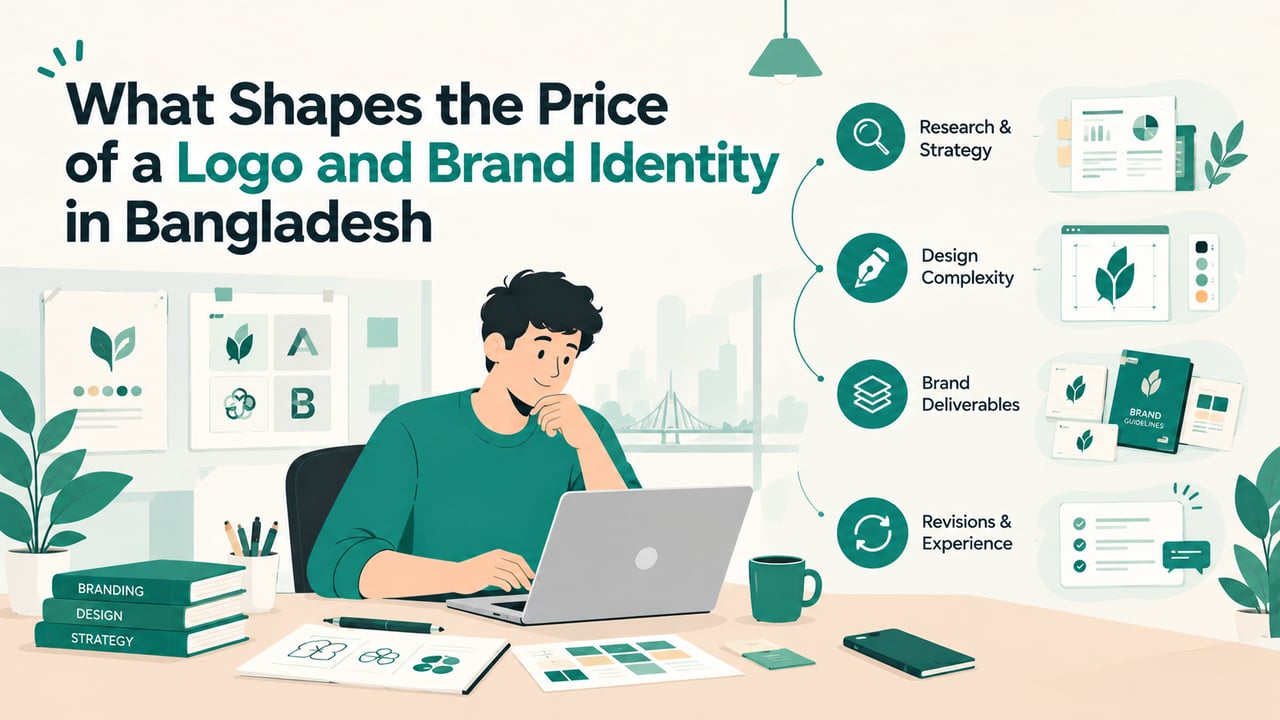
They are not selling the same thing. Logo design cost in Bangladesh varies so widely because a quote can cover anything from a single image file to a full identity system with research, guidelines and a legal transfer of ownership. Once you can see which of those pieces a quote includes, the numbers start to make sense, and you can tell whether a cheap quote is a bargain or simply missing half the job.
This guide does not publish a price list. Prices move with scope, and a number without the scope behind it is exactly the problem. Instead, it walks through each part of a logo and brand identity project, what it adds to the price, and what to check before you pay a deposit. It also covers something most pricing guides skip: what Bangladesh's Copyright Act 2023 says about who owns a logo you paid for.
Key takeaways
- Logo quotes differ mainly in scope: research, the number of concepts, the system around the logo, the files you receive and the rights you get.
- The logo mark is often the smallest part of a brand identity project. Research, the system and the guidelines take most of the time.
- Under the Copyright Act 2023, the designer is the first owner of a commissioned logo unless they are your employee. Ownership reaches you through a signed assignment.
- An assignment that does not state its duration or territory is treated as lasting five years and covering Bangladesh only. Read that part of your contract.
- Compare quotes line by line with the checklist near the end of this article, not by the total.
Why logo quotes are so far apart
Every logo quote is a bundle of three things: thinking, design and rights. Templates and quick marketplace logos keep the price low by cutting the first and the third almost entirely. You get design, often a single direction adapted from something that already exists, and a file. Agency and senior freelance quotes include all three, and the thinking and the rights take a large share of the time.
Neither is automatically wrong. A home-based business testing a product on Facebook may not need a researched identity system yet. A company printing packaging, signing up distributors or selling abroad usually does, because a brand is expensive to change once it is on boxes, signboards and marketplace listings. The useful question is not which quote is cheaper. It is which quote covers what your business will need over the next few years.
What goes into the price, line by line
These are the parts that appear, in some form, in most professional logo and identity quotes. When a quote says only "logo design", use them as your questions.
Discovery and research
Before anyone sketches, someone has to understand who you sell to, who you compete with and what you want people to remember. In a structured project, that means a short workshop or questionnaire, a look at competitors' branding, and a written brief you both agree on. It is the least visible part of the job and the first thing cheap quotes leave out. Without it, you end up choosing between designs on personal taste, and the logo that wins the family vote is not always the one customers remember.
Concepts and revision rounds
The number of initial concepts is one of the biggest price levers, and more is not always better value. Every extra direction is designer time spread thinner, so a low quote promising ten concepts is usually offering variations on one idea rather than ten developed ones. Pay more attention to how concepts are presented. A strong quote shows each direction applied to real uses such as a shop sign, a social post and a product label, because a logo that looks good on a white page can fall apart at the size of a profile picture.
Check the revision terms as well. "Unlimited revisions" tends to mean either small cosmetic changes or an argument later about what counts as a revision. A fixed number of rounds with a clear process is easier for both sides to keep to.
The logo suite
Businesses rarely use just one version of a logo. You need a primary logo, a horizontal version for website headers and signage, a stacked version for square spaces, and an icon or symbol that still reads at the size of an app icon or a WhatsApp profile photo. Each version is design work and has to be tested at small and large sizes. If a quote lists "one logo", ask whether these versions are included or charged later.
Colour and typography, in English and Bangla
A colour palette and a type system turn a logo into something your team can build with. A professional palette gives exact values for screen and print and checks that text on those colours stays readable. The type system names the fonts for headings and body text and, for many Bangladeshi brands, for Bangla. Pairing Bangla and Latin type so they look like one brand is specialist work, and quotes written with English in mind often leave it out. If your customers read Bangla, ask how the quote handles it.
Brand guidelines
Guidelines explain how to use everything above: the space to leave around the logo, minimum sizes, how to use the colours, what not to do, and examples of each. They are what lets a printer, a new team member or your next agency produce material that looks like your brand without calling the original designer. A one-page guide and a thirty-page manual are very different amounts of work, so ask what a quote means by "guidelines".
Templates and applications
Some quotes include everyday pieces built on the new identity: social post templates, business cards, letterhead, invoices or packaging labels. They cost money now and save money later, because your team can produce new material from them instead of commissioning each piece. They also prove that the identity works outside a presentation, which is why our own brand concept studies show each identity across social posts and campaign layouts rather than on a blank page, and our own identity is documented down to signage and stationery. If templates are not in a quote, budget for them separately.
The file package
At the end, you need the right files. That normally means vector files (SVG, PDF or the designer's source files) that scale to any size without blurring, PNG files for everyday digital use, full-colour and single-colour versions, and a version for dark backgrounds. A quote that delivers only a JPG or PNG is cheaper because it is less work. The first time a printer asks for a vector file or a signboard maker needs a large version, you will pay someone to redraw it.
Timeline and who does the work
Rush jobs cost more because they push other work aside. Seniority costs more too: a project where a strategist, a designer and a reviewer all work on your logo costs more than one person's afternoon. Ask who will actually design your logo, and whether that is the person whose portfolio you were shown.
Who owns the logo you paid for?
Most buyers assume that paying for a logo means owning it. Bangladeshi law does not make that automatic, and few pricing guides mention it.
Under the Copyright Act 2023 (Act No. 34 of 2023), the author of a work is its first owner (section 15). A logo is an artistic work, and the Act's definition of artistic work expressly covers graphics and designs created on digital devices (section 2(40)). There is an exception for work made by an employee under a contract of service: the employer becomes the first owner unless they have agreed otherwise. A freelancer or an agency you hire is not your employee, so by default they hold the copyright in the logo they made for you.
Ownership reaches you through an assignment, and section 17 of the Act sets the conditions. The assignment must be signed by the person assigning the rights or by their authorised agent. It must identify the work and state which rights are assigned, for how long, and for which territory. Two default rules in that section matter to anyone buying a logo:
- If the assignment does not state a duration, it is treated as made for five years from the date of assignment.
- If it does not state a territory, it is treated as covering Bangladesh only.
For a business that exports, sells online to customers abroad or may register its brand in other countries, an assignment that is silent on these points leaves a real gap. The Act also requires assignment deeds to be registered with the Copyright Office (section 16(6)), and an assigned right that is not used within a year can lapse unless the deed says otherwise (section 17(4)).
The practical step is simple. Ask for a written, signed transfer of rights that names the logo and identity, assigns the rights in full, for the full term of copyright and worldwide, and lists the files you will receive. The designer keeps the moral right to be identified as the author (section 78), which does not stop you using, adapting or registering the logo. This is general information, not legal advice. For a contract your business will rely on, have a lawyer check the wording.
Trademark registration is a separate step
Copyright protects the design as a creative work. A trademark protects your use of it as a brand in trade. In Bangladesh, trademarks are registered with the Department of Patents, Designs and Trademarks (DPDT) under the Trademarks Act 2009, which defines a mark to include devices, labels, names, symbols and combinations of colours. A registration lasts seven years and can then be renewed for periods of ten years (section 22). Registration fees and any lawyer's or agent's fees are not part of a design quote, so budget for them separately. Before you approve a final design, ask your designer to check for obviously similar marks in your category.
Costs that hide inside a cheap logo
Some quotes are low because they leave risks with you. Three are worth checking before you sign.
Fonts
Fonts are software, and they come with licences. Fonts released under the SIL Open Font License can be used in logos, as the licence's official site states. Many commercial fonts need a paid licence, and the terms for logo use vary from one foundry to another. Ask which fonts your logo uses and whether you, rather than the designer, hold any licence that is needed. The same applies to Bangla fonts: check the licence of the specific font instead of assuming it is free.
Stock and borrowed elements
A logo built from a stock icon or a template can look finished at a low price, but it is hard to own, and harder to register, something other businesses can buy too. Ask the designer to confirm in writing that the logo is original and contains no stock, template or other third-party elements.
AI-generated logos
AI image tools can produce logo ideas in seconds, but the law on owning their output is still settling. In January 2025, the U.S. Copyright Office concluded in Part 2 of its report on copyright and artificial intelligence that prompts alone do not give a person enough control to be the author of what the tool generates, while human selection, arrangement and modification can still be protected. Bangladesh's Copyright Act 2023 does not mention AI-generated works. If a designer uses AI anywhere in your project, ask them to say where, and make sure the final logo is drawn and refined by a person.
How to compare two logo quotes
Put the quotes side by side and answer each question for each one. Where a quote is silent, ask. A gap is not the same as an inclusion.
- Discovery: is there a workshop, questionnaire or written brief before design starts?
- Concepts: how many directions, and will they be shown in real applications?
- Revisions: how many rounds, and what counts as one round?
- Logo suite: are primary, horizontal, stacked and icon versions included?
- Colour: does the palette include values for screen and print, with readability checked?
- Typography: are fonts named for headings and body text, including Bangla if you need it?
- Licences: who holds any font licence, and is the logo free of stock or template elements?
- Guidelines: how long are they, and what do they cover?
- Templates: which everyday pieces are included?
- Files: will you receive vector (SVG, PDF or source), PNG, colour and single-colour versions?
- Rights: is there a signed assignment of full rights, worldwide, for the full term, on payment?
- Timeline: are there dates for each stage, and what happens if feedback runs late?
- Payment: what is the deposit, what are the milestones, and what do you receive if the project stops halfway?
- Support: who answers questions after handover?
When a logo on its own is enough
Not every business needs a full identity system on day one. If you are testing a product, selling mostly to friends and followers, or may change your name within the year, a simple, well-drawn logo with vector files and a one-page note on colours and fonts is a sensible start. Put the rest of the budget into the product.
Move to a full identity when the brand starts appearing in places that are expensive to change: printed packaging, signboards, uniforms, a website, marketplace listings or partners' materials. From that point, the cost of inconsistent material, reprints and a later redesign usually outweighs the cost of doing the system properly once.
Our own advice on the branding service page follows the same line: we will design just a logo, but the smallest package we recommend is a logo with a short one-page guideline, because a logo without colour, type and usage rules tends to drift within months.
Frequently asked questions about logo design cost
How much does logo design cost in Bangladesh?
There is no single market price. Marketplaces, freelancers and agencies quote for very different scopes, so their totals are not comparable on their own. A useful quote states exactly what it includes. Compare scope first and price second, using the checklist above.
How long does a logo and brand identity take?
A simple logo can be done in days. A full identity with research, concepts, refinement, guidelines and templates takes longer, mostly because each feedback round needs time on both sides. Ask for a date for each stage rather than a single deadline.
Do I own my logo once I have paid?
Only if the rights are transferred to you. Under the Copyright Act 2023, a freelancer or agency is the first owner of a logo they create for you, and ownership passes through a signed assignment that names the work, the rights, the duration and the territory. Ask for one in writing.
Should I register my logo as a trademark?
If the brand matters to your business, it is worth considering, especially before you invest heavily in packaging or expand into new markets. A lawyer or trademark agent can search for similar marks and file with DPDT. Those fees are separate from the design fee.
Is an AI logo generator good enough?
As a placeholder while you test an idea, it can be. For a brand you plan to invest in, the uncertainty over ownership, the risk of looking like other marks and the lack of any system around the logo make it a weak foundation.
Compare scope first, then price
A logo quote is only cheap or expensive relative to what it includes. Once you can see the research, the system, the files and the rights inside each number, choosing between quotes becomes a business decision rather than a guess.
WeezLab designs logos and brand identities as one system: discovery, a logo suite tested at every size, colour and type that work in English and Bangla, guidelines, templates and a complete file package. Every project is quoted as a fixed scope, and the rights and source files are yours once it is paid. If you have a quote in hand or a brief in mind, send it to us and we will come back with a fixed-scope quote you can compare line by line.